29
Reality is Deciduous.
One winter my wife and I were about half an hour across the Ohio border when she broke the road weary silence with this:
“If we were explorers or pioneers, and had no previous understanding that trees do this,” she said, pointing to the miles of leafless, dormant trees lining the highway, “can you imagine how it would seem?”
She went on to explain her question.
To the uneducated the whole landscape, stretched in browns under a winter grey sky, looks dead. With the exception of a few pine trees and their sporadic dots of green, everything looks expired. It would seem for those unacquainted with the seasons that something bad had happened. A bomb had gone off. Maybe a great fire had consumed the state. A terrible disease had swept across the whole country and all but those last green survivors were gone. You would have every reason to believe death had had its way and you’d want out of there.
But we aren’t uneducated. Much the opposite, since we grew up where there are deciduous and coniferous trees. So, we know almost instinctively that trees do this from about October through March. No sense of fear or grief follows. A vague sense of revulsion if you’re as unappreciative of the cold as I am, but not despair.
Just wait, we think. Spring is coming. Winter’s a season, not a final state.
Deciduous trees shed their leaves. The Latin decidere means to “fall down” or “fall off”. Coniferous, or cone-bearing, are Evergreens and are ever green. This is kid stuff. We know it like we know about the effects of gravity and excessive beans in our diet. We learned early the trees aren’t dead when they look so. Without this rudimentary knowledge what is temporary would have the convincing appearance of permanence. We assume a cycle without knowing we do, despite finality being better supported by the immediate evidence.
Imagine seeing a sunset for the first time as a conscious adult. It wouldn’t be beautiful at all. How terrifying that the great source of life-sustaining light and heat was dissolving into the horizon, slowly turning the sky red, then pinks, and then petering out and surrendering to the victory of night. Imagine a child walking up to you in your terror, your hands on your face, tears in your eyes; “It’s ok, sir. It comes back up over there in the morning.” Isn’t part of what makes a sunset not terrifying but instead, beautiful, because we know about morning?
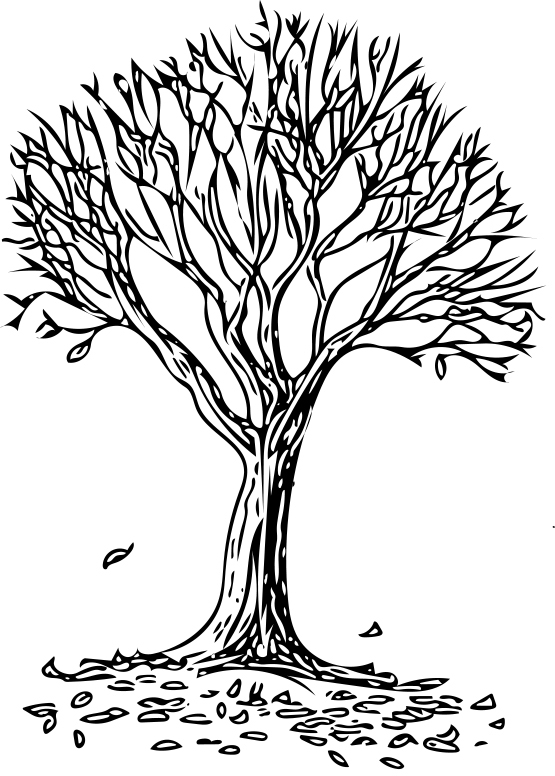
People of faith are supposed to be paying very close attention, so that we can be more and more acquainted with the cyclical ways of pain and grief, and of death. Discomfort and hardship can’t be avoided – often can’t even be reduced by prayer in my observation -but neither are they final. I’ve spent so much of my life avoiding falling down or falling off. Because I learned somewhere that falling is the end. I have feared pain and I have feared death. Somewhere, probably like you, I learned life was one great straight line, rather than the circles and cycles it really is.
I am slowly learning to live more deciduously, because I think all reality might be so.
In speaking about the temporality of death, Paul rhetorically asked his friends in Corinth, “Where is Death’s sting? Where is Death’s victory?”
The is an ironic thing for a man who has since completely decomposed to say. But he was only in part speaking about the future state of “Paul.” He was also speaking to what happens within us when we come to recognize, with conviction, that death is a nonnegotiable, yet revocable. When death becomes penultimate in my mind, then it loses its ability to make me desperate. It becomes a troubling winter, but not despair. Spring comes next. The sun comes back up over there tomorrow.
Jesus gave the picture of a seed falling to the ground to make life. The seed dies, separated from its life source. It is buried, out of view. And then it is raised up to new life. This was one way he spoke of his life, death, burial and resurrection. A thing he said we have coming as well. Paul said the same before he asked about Death’s sting. These are metaphors, the actuality of which I have not yet experienced in full to encourage you about what lies on the other side of you or your loved ones dying. I’ll let you know.
But I have seen that, as I get older, calmer, less concerned with cheating the inevitability of pain and death, I am more able to live. And to Love.
We live in the unending cycles of joy and sorrow, of work and rest, of laughter and weeping, of faith and doubt, of living and dying. This is human life. Fighting against this only makes me miserable. I had this backwards for most of my life.
Misery comes when I believe I can somehow achieve perpetual Spring. Through money or more faith.
Misery is believing the hardship I’m currently experiencing is the end of the story, despite being able to look back and see I’ve survived – even benefitted from – every single thing that’s happened to me.
My choice to live deciduously is way of embracing the cycles, the seasons, as necessary components of one reality. To live trying to cling to one and avoid the other is a recipe for an anxious, desperate existence. And I will make you pay for this anxiety. I will make you my pharmacy, or the object of my disappointment. This is the song and the victory of Death.
Admit it:
You have some things going well in your life. But the leaves will someday fall off of it. This is nothing to become anxious or fretful or clingy about. That’s just how it goes. Enjoy it.
You have some things that have gone to hell in a handbag. Someday, those seemingly dead branches will look like life again. It may be a long winter. But it’s still a season. Those branches will sprout again. You can’t escape it. And upsetting yourself solves nothing. Learn from it. When Spring arrives you might be able, from the depths of experience rather than a book or a sermon, educate others who think leafless trees are forever dead.
And this will be your living in resurrection. This will be one of your greatest acts of self-calibrated Love of others.