The one who came to give life, buckets of it, was now hanging dead on a criminal’s execution stake.
“When the centurion, who stood there in front of Jesus, saw how he died, he said, ‘Surely this man was a son of God!’”
It’s likely this centurion, a trained killer and leader of a hundred of Rome’s finest, had been in charge of everything that happened to Jesus after Pilate sentenced him. He’d overseen Jesus being whipped to shreds. He’d observed him beaten and mocked. He’d seen the insults hurled at him from his own people. Like he had countless times before with so many other accused, the centurion had overseen this Jesus being tacked up on a tree so the public could see his body and his reputation die.
But what he hadn’t seen is what caught his attention. Unlike so many criminals executed before, he never saw this Jesus become ugly or disparaging.
Not one time did he blame.
He didn’t spit back, swing, argue or threaten.
He wept and groaned, but without venom.
And honest to God the man even prayed for the forgiveness of those involved in his crucifixion.
The centurion had never been prayed for by one he was killing. It was as though this man from Nazareth had kept himself untouched from the very hate that was murdering him. It was a strength rooted in a very different soil than he himself, a conquering Roman, had been planted in.
“Son of God” was a title applied to Caesar. We can find the phrase on coins and columns from Roman antiquity. Like so many despots before and after, Caesar’s power came largely from his being perceived as the savior of mankind, the absolute principal of the civilized world. Caesar was the Empire- the king of the kingdom of peace. Anyone who disagreed was subject to slaughter in the name of this peace. Rome was a machine fueled by military might and was destined to overcome the world. The centurion upheld this glorious purpose on oath.
And yet here was one bleeding out on a cross, mocked with a sarcastic sign about his kingship hanging over his head, representing something more powerful than “power.” And it was one of the most remarkable things the centurion had ever seen. We can’t know what happened next for the centurion. Perhaps that doesn’t matter. Perhaps seeing one trained under the ideology of Pax Romana, a peace at gunpoint, shift slightly is enough story for us to benefit from.
But this still leaves me why the day Christ was crucified be named Good Friday. The short answer some of us may give is because it was good for us that the Christ died for our sins. But perhaps we should consider that it might have been a bad Friday if King Jesus had simply made sure that true justice was served, that the murderers and the liars and the cowards and the betrayers were dealt with in full accord with the law. That the filthy were thrown away and the clean were embraced and allowed to sit on Heaven’s furniture. Jesus could have displayed his great and magic power against that of the Empire. He could have wiped them out if he truly was the god-man. Not even Empire, in its sprawl across half the globe could have survived a pinch of God’s might. Them and all the liars and the dirty, dirty cheats of the world, eliminated. And I suppose it would have been justified. Maybe it wouldn’t have been such a bad Friday if Christ would have done what was warranted.
And perhaps that’s just it. That’s the paradox. What makes Good Friday good is that what was justified went undone. Instead, innocence and beauty willingly absorbed evil ugliness. Compassion trumped the vicious brutality required of a person to nail Jesus to a tree. It wasn’t fair or right. It could and should have been avoided. But it happened. It happened and it was swallowed up in Love, cancelling the sin and brutality out rather than escalate it. What was arguably “fair” was exchanged for “Good.”
With a bit of reflection we realize many of us have seen this in our own time. Men and women of incredible Love, confidence and self-control, not reacting to the evil of their circumstances, but somehow absorbing it. Refusing to let the craziness spiral on for even a moment more, because they realize good can only come when one chooses not so much to win, but to forgive. They circumvent Newton’s Third Law and don’t push back with the same force, the same level of consciousness. They respond under a different Law and the energy of harm is absorbed.
Christ is the King of such people. Deep down, you and I are such people.
“You have heard people say, ‘An eye for an eye and a tooth for a tooth.’ But I tell you, Don’t get into tug-o-wars with those who are evil. Instead, if anyone slaps you on the right cheek, turn to him the left also…”
The King absorbed evil on Good Friday like even the dimmest candle chews up all the darkness in a room. Because of this, the world would be gradually, over decades and centuries, grabbed by the collar and shaken into various stages of wakefulness. And here we are, generations later, staring at a cross bewildered and inspired.
Wait a minute.
Is this how the world is saved?
By overcoming evil with Love rather than with more evil?
By forgiving and considering rather than justifying any means required to win?
By absorbing a wrong rather than retaliating against it?
Is this what a Son of God looks like?
“In Christ all the fullness of God was pleased to dwell, and through Christ to reconcile to himself everything, whether things on earth or things in heaven, making peace for everything by the blood of his cross.”
I’d argue it’s a Good Friday because what Christ did on the cross wasn’t magic. It’s Good Friday because what happened on it shows us the beauty of being conquered by the audacity of Love. Not just for a person here or there, but for all that exists, things above and below. All of it can be set right by the Christ, as well as by Christ’s people as they follow suit in taking up their own cross and demanding others pay no more.
If this sounds hard, it is. It’s also easy to misunderstand, and as a result of this misunderstanding faith looks to many like letting abusive people abuse you. It’s her cross to bear. This is a tragic suspension of self-love, which I hope by this point has been reconsidered as something to scale down but never eliminate. Yet even with a healthy understanding of ourselves and the harm leveled at us by others, this absorption and forgiveness bit is as hard as it gets. Can there be anything as difficult as mimicking Christ’s Love for those he, to the degree he was also fully human, was justified in hating?
But it’s even harder to go on living like the centurion was taught to live by his god. Far harder to look at life as acquiring wins and the avoiding ego-damning losses. It’s far more miserable to maintain citizenship in the Empire of the Tick. It’s just plain harder to live apart from our essential nature, which is Compassion and Love. Somehow, choosing the harder way, is where peace seems to be.
Christ died. And Christ lives again. “Follow me,” said this Christ.
The rewards are anything but immediate. But from the very first moments it has had an affect on even the most unlikely of shows us the beauty of being conquered by the audacity of Love. Not just for a person here or there, but for all that exists, things above and below. All of it can be set right by the Christ, as well as by Christ’s people as they follow suit in taking up their own cross and demanding others pay no more.
If this sounds hard, it is. It’s also easy to misunderstand, and as a result of this misunderstanding faith looks to many like letting abusive people abuse you. It’s her cross to bear. This is a tragic suspension of self-love, which I hope by this point has been reconsidered as something to scale down but never eliminate. Yet even with a healthy understanding of ourselves and the harm leveled at us by others, this absorption and forgiveness bit is as hard as it gets. Can there be anything as difficult as mimicking Christ’s Love for those he, to the degree he was also fully human, was justified in hating?
But it’s even harder to go on living like the centurion was taught to live by his god. Far harder to look at life as acquiring wins and the avoiding ego-damning losses. It’s far more miserable to maintain citizenship in the Empire of the Tick. It’s just plain harder to live apart from our essential nature, which is Compassion and Love. Somehow, choosing the harder way, is where peace seems to be.
Christ died. And Christ lives again. “Follow me,” said this Christ.
The rewards are anything but immediate. But from the very first moments it has had an affect on even the most unlikely of people. As we step out of Lent and into Easter Weekend may we, as the unlikely centurion may have, leave one kingdom for the Other. May we see clearly what we’ve been blind to. May we entertain that we are being offered a place in the salvation of not just certain people, but of everything. It is all Loved, because it all comes from Love. So do you. So do I.
May we have our notions about this God called Love, dying at our own ignorant, anxious hands, dismantled. May we find ourselves awakened and saying to each other, somewhat surprised and confused,
“Oh…Oh! This is the Son of God. This is Love.”
And then, let’s be as he is.
31
Look Out Below.
Pontius Pilate can’t understand what the big deal is. The crowd was worked up to a kosher lather about this Jesus fella from Nazareth and him being guilty of some or another crime. There were always fires to put out in this part of the Roman Empire. He’d just volleyed a few times with this Jesus in an inner room, finding himself confounded by a discussion of what’s true. What’s real.
“I’ve interviewed him,” Pilate announces to the angry assembly. “I don’t see that he’s guilty of anything.”
“He claimed to be king!” yelled one.
“He threatened to destroy our Temple,” said another.
“He thinks he’s God. But we lack the sovereignty to execute him for it!” It was a dog pile now.
Pilate rubbed his head, wishing Passover would pass over. It was customary to release a prisoner to the Jews every Spring, at Passover. The irony of a man playing God with the Israelites, allowing the Exodus of a Hebrew, was not lost on the crowd.
“This year for release, how about I release to you this King of you Jews.” He was trying to put out a fire with sarcasm. Pilate must not have been married for very long.
“No!” They screamed. “Not him. Give us Barabbas!”
Barabbas is labeled here in the story as a thief. But his brand of thievery is different than the guy who busts your window to take your car stereo. Barabbas is an insurrectionist. A Robin Hood type, who leads brigands, who may or may not have been merry, to take from those who have and redistribute it to those who don’t. Barabbas was a revolutionary.
Barabbas, whose name is Aramaic and literally means “son of a father” would have had a following. Supporters. Teens would have worn Barabbas t-shirts. Parents would have been torn over whether a guy like Barabbas was of God, or something else. He had a vision and a challenge to anyone who’d listen. Doubtless he spoke powerful words about what it would require to take the world back from the corrupted powers and set it all right again. There was a way things ought to be. And any means to get it there were justified by that Glorious End. Murder, upheaval, reversal of power. To God be the glory.
“Do you Jews want me to pardon Barabbas,” Pilate asked. “The revolutionary who wants to change things? Change how people are and how systems work and what people value? The change agent with a vision and a strategy and the chops to garner a following…
“or….
“Do you want this other leader? A revolutionary, with a vision, but who goes about things differently does he not? He speaks of a Kingdom superseding Caesar’s while he plays with children, treats women as equals, surrounds himself with bad résumés and washes the feet of people who don’t have any clue what the gesture symbolizes. One who forgives to the point of the ridiculous and who says the trajectory of true Compassion is to be able to love even your enemy.”
“Do you all want a son of a father, or the Son of the Father?”
“Not Jesus,” they said. “Give us our Barabbas.”
So the guards took Jesus, beat him and killed him while Barabbas went home and got a shower. And before I start shaking my head at all this, I should probably admit to myself that I usually ask for Barabbas too. It’s hard to blame the people then. Jesus went to Jerusalem to die; what lasting good could that possibly accomplish?
They wanted something they thought would work. “Give us someone great! We want to be part of something great! This Jesus is the wrong direction if we’re ever going to have lives worth living.”
I would have been right there chanting Barabbas’s name with them. Not because I’m a vile sinner who’s fun to imagine hissing and writhing in the bloodthirsty crowd. But because if things are going to change, if my world, my city, my culture, are going to make it all the way through, then give us someone who can fight to preserve it. To save it! How else will I know we succeeded?
When Jesus got into the city earlier that week he all but set the scene up for his disciples:
“I tell you honestly, unless a seed falls into the earth and dies, it remains just that, a seed. But if it allows itself to die, it bears much fruit. Whoever prioritizes the preserving of his own life ends up losing it, and whoever resists this impulse will find themselves living an eternal quality of life now and forever. If anyone wants to serve my interests, he must follow me. So that wherever I am, you’ll automatically see my servants are there too.”
It’s almost too risky to adopt. It reads wonderfully on Sunday morning, but in the real day-to-day, this is insanity. Especially when it matters most. Why would I rationally choose your interests over mine? Why would I spend my life’s energies calibrating myself to give your interest priority. Why would I choose to throw the game for the opponent?
“Perhaps the answer can be found in the fact that you’ve never been to a Church of Barabbas. That movement didn’t take.
It’s the heart of Ahava, our true self, that responds to Christ’s crazy idea. Even as we call it unrealistic, we read it, we see glimpses of it at work or in traffic, and we feel the whisper of the Cosmos calling to us. The one who showed us how to give himself away for the sake of the other, who Creates not by force but by gentle consideration, and cooperation, is what is deepest within ourselves.
We worship Christ. But we ask for Barabbas.
That may be why he didn’t stop at the seed and the dying and losing thing. He added a bit about following him. Which we can reasonably assume means right into the maw of death, into forgiving those responsible for it, and out the other side prepared to watch the world recalibrated by Love. He didn’t want us to merely agree. We’re supposed to go do this, work it all out in the real world.
I am incrementally more willing to be one who dies as an act of my own will. I’m a seed with strong hands, clutching the vine in desperation, unwilling to be obscured, forgotten, to suffer the loss of me. But I am losing faith in the way of Barabbas, because I’ve tried to make revolution his way and it’s only made me tired.
And, so, here’s to weakened hands and the ensuing strength of Christ.
30
Behold, I Make All Things Nude.
See from His head, His hands, His feet,
Sorrow and love flow mingled down!
Did e’er such love and sorrow meet,
Or thorns compose so rich a crown?
There is an ancient tradition of contemplating the beaten and then crucified body of Christ. And then to consider the apparent scarring even his resurrected body maintained. But there’s one detail about his body that may feel a little strange to meditate on.
Blood.
Nail-scarred hands.
Nail-scarred feet.
Spear-pierced side.
Thorn-stabbed head.
Completely naked.
When he died Jesus was wrapped up in grave clothes and placed in what turned out to be a borrowed tomb. The Gospel of John tells us it was a tomb in or adjacent to a garden. Jesus went into it wrapped up like a mummy and the door was sealed.
A seed planted in the ground.
The following Sunday morning Jesus wasn’t where they put him. The disciples went to confirm the rumor and were devastated to find that the body of their Lord, and the place they would have commemorated him, had been taken from them. Mary Magdalene hung back near the tomb as the men went away drawing up a silly fix to the problem as men are prone to do.
Suddenly Mary is speaking to a man she doesn’t immediately recognize. John helps us understand what she did with her lack of recognition; he said she assumed she was speaking to the gardener.
It would be a few beats until she realized she was speaking to the very much alive Jesus of Nazareth. She went from this conversation to tell the others this amazing news, becoming the world’s first Evangelist of the Resurrected One. Strange how the church has historically been so resistant about women preaching. They started it.
But the detail we often overlook as we talk about the empty tomb is that it wasn’t exactly empty. When the men looked inside, they found an important something. Grave clothes.
Clothes. Folded neatly.
Jesus, the consummate guest.
This unabashedly puts a nude Jesus in our heads if we pay attention. As one rarely paying full attention to anything, I didn’t see it until it was pointed out to me. Not even to John saying, “Mary thought she was speaking to the gardener,” which might have been a little on the nose.
A naked gardener is raised to life in a garden, at the end of John, a book that begins with the same three words as the opener in Genesis: “In the beginning.”
The Apostle Paul offers help:
“Christ has been raised from the dead, the first Yield of the larger harvest made of those who have ‘fallen asleep’. Just as death came long ago through a man, now resurrection of the dead also comes through a man. Just as in Adam all must surrender to death, so in Christ all will be made alive…So it is written: The first Adam became a living being, the last Adam: a life-giving spirit.”
The resurrection, as I hope has become clear, isn’t just an assurance of the continuation of life. In that the resurrection was like this, naked and vulnerable, harkening back to the original story of unobstructed connection in the Garden, we seem guided to learn to resurrect now. Like all Kingdom things, it’s wherever we are. Buried in the field. Lost in our own house. Not so much “there!” or “there!” but within us, waiting to be brought to life, uncovered and shameless.
Death belongs in the tomb wrapped up and unseen. Guarded. Love lifts it out, unveiled and unhidden, allowing us to live together at peace and at one.
What point is there to any of this if resurrection can only resuscitate corpses, but not resuscitate what’s already dead in me – dead between you and I – now? We’re going to miss the resurrection if we keep thinking of it as only getting to live forever. Easter then becomes a celebration about a life we can’t get to yet. A life we aren’t ready for anyway. First, we have to start getting what’s unknown, known. Start facing our fear of shedding fig leaves and grave clothes. Start thinking about being naked Earth dwellers who are unfit to float in robes forever. Christ, naked and unafraid, draws my self-protected anxiety out of my tomb and into the light. Where we all are being drawn. Back together, with nothing to hide.
“O loving wisdom of our God!
When all was sin and shame,
A second Adam to the fight
And to the rescue came.”
29
Reality is Deciduous.
One winter my wife and I were about half an hour across the Ohio border when she broke the road weary silence with this:
“If we were explorers or pioneers, and had no previous understanding that trees do this,” she said, pointing to the miles of leafless, dormant trees lining the highway, “can you imagine how it would seem?”
She went on to explain her question.
To the uneducated the whole landscape, stretched in browns under a winter grey sky, looks dead. With the exception of a few pine trees and their sporadic dots of green, everything looks expired. It would seem for those unacquainted with the seasons that something bad had happened. A bomb had gone off. Maybe a great fire had consumed the state. A terrible disease had swept across the whole country and all but those last green survivors were gone. You would have every reason to believe death had had its way and you’d want out of there.
But we aren’t uneducated. Much the opposite, since we grew up where there are deciduous and coniferous trees. So, we know almost instinctively that trees do this from about October through March. No sense of fear or grief follows. A vague sense of revulsion if you’re as unappreciative of the cold as I am, but not despair.
Just wait, we think. Spring is coming. Winter’s a season, not a final state.
Deciduous trees shed their leaves. The Latin decidere means to “fall down” or “fall off”. Coniferous, or cone-bearing, are Evergreens and are ever green. This is kid stuff. We know it like we know about the effects of gravity and excessive beans in our diet. We learned early the trees aren’t dead when they look so. Without this rudimentary knowledge what is temporary would have the convincing appearance of permanence. We assume a cycle without knowing we do, despite finality being better supported by the immediate evidence.
Imagine seeing a sunset for the first time as a conscious adult. It wouldn’t be beautiful at all. How terrifying that the great source of life-sustaining light and heat was dissolving into the horizon, slowly turning the sky red, then pinks, and then petering out and surrendering to the victory of night. Imagine a child walking up to you in your terror, your hands on your face, tears in your eyes; “It’s ok, sir. It comes back up over there in the morning.” Isn’t part of what makes a sunset not terrifying but instead, beautiful, because we know about morning?
People of faith are supposed to be paying very close attention, so that we can be more and more acquainted with the cyclical ways of pain and grief, and of death. Discomfort and hardship can’t be avoided – often can’t even be reduced by prayer in my observation -but neither are they final. I’ve spent so much of my life avoiding falling down or falling off. Because I learned somewhere that falling is the end. I have feared pain and I have feared death. Somewhere, probably like you, I learned life was one great straight line, rather than the circles and cycles it really is.
I am slowly learning to live more deciduously, because I think all reality might be so.
In speaking about the temporality of death, Paul rhetorically asked his friends in Corinth, “Where is Death’s sting? Where is Death’s victory?”
The is an ironic thing for a man who has since completely decomposed to say. But he was only in part speaking about the future state of “Paul.” He was also speaking to what happens within us when we come to recognize, with conviction, that death is a nonnegotiable, yet revocable. When death becomes penultimate in my mind, then it loses its ability to make me desperate. It becomes a troubling winter, but not despair. Spring comes next. The sun comes back up over there tomorrow.
Jesus gave the picture of a seed falling to the ground to make life. The seed dies, separated from its life source. It is buried, out of view. And then it is raised up to new life. This was one way he spoke of his life, death, burial and resurrection. A thing he said we have coming as well. Paul said the same before he asked about Death’s sting. These are metaphors, the actuality of which I have not yet experienced in full to encourage you about what lies on the other side of you or your loved ones dying. I’ll let you know.
But I have seen that, as I get older, calmer, less concerned with cheating the inevitability of pain and death, I am more able to live. And to Love.
We live in the unending cycles of joy and sorrow, of work and rest, of laughter and weeping, of faith and doubt, of living and dying. This is human life. Fighting against this only makes me miserable. I had this backwards for most of my life.
Misery comes when I believe I can somehow achieve perpetual Spring. Through money or more faith.
Misery is believing the hardship I’m currently experiencing is the end of the story, despite being able to look back and see I’ve survived – even benefitted from – every single thing that’s happened to me.
My choice to live deciduously is way of embracing the cycles, the seasons, as necessary components of one reality. To live trying to cling to one and avoid the other is a recipe for an anxious, desperate existence. And I will make you pay for this anxiety. I will make you my pharmacy, or the object of my disappointment. This is the song and the victory of Death.
Admit it:
You have some things going well in your life. But the leaves will someday fall off of it. This is nothing to become anxious or fretful or clingy about. That’s just how it goes. Enjoy it.
You have some things that have gone to hell in a handbag. Someday, those seemingly dead branches will look like life again. It may be a long winter. But it’s still a season. Those branches will sprout again. You can’t escape it. And upsetting yourself solves nothing. Learn from it. When Spring arrives you might be able, from the depths of experience rather than a book or a sermon, educate others who think leafless trees are forever dead.
And this will be your living in resurrection. This will be one of your greatest acts of self-calibrated Love of others.
28
Diss-ciples.
Forget you ever saw Da Vinci’s Last Supper. It’s a beautiful work, yes. I’m told you can even replace the pieces of bread dotting the table with musical notes and get a pretty great funeral dirge. But take it out of your mind. Because you may have an image in your head where all these men were basically the same. Variations on a theme, different robe and beard thicknesses, but essentially copies of each other. The Apostles.
Rather than thinking of only Judas as the one dissident – and of course he was the most potent one – try and see these men for who they were. How they thought.
Peter, Andrew, James and John. Fisherman who had lately felt forced to fish all day and all night in the overfished Sea of Galilee. “Damn those Romans” they said to their empty nets for the seeming insatiability for fish the Empire had, even as this Empire showed little regard for the hands that netted them.
Thomas wasn’t so much a doubter as he was a cynic. Messiahs come and go, was Thomas’s skeptical take. Tales of miracles and bold teaching were as common as the bone boxes they ended up in. “Might is right, and no one has might like Caesar. Get used to it,” Thomas said to anyone who wondered about God’s Kingdom ever being realized.
Simon the Zealot had some inflammatory views about all this. “You gotta fight fire with fire!” he’d say. The Zealots often carried little daggers in their robes, waiting for an opportune time to assassinate a government leader in the market or during a parade, in hopes to foment the unrest needed for a bottom-up revolution to begin. Overpower the powers that be. Would God call God’s warriors to any less?
Imagine the table, these men sitting there complaining, counter-complaining, pointing out the appreciable fact that complaining accomplishes nothing but ulcers.
Imagine now Matthew sitting between them quietly. Remember, Matthew’s job prior to his joining Team Jesus was tax collection. In a world where the temple, its compulsory offerings and numerous fees for being, coupled with Roman taxes, amounted to well over half your income. Imagine how Jewish men felt about a Jewish man who excised tax on, say, fish. Ancestral land. All for the Empire. Imagine how Matthew felt when Simon Z. got his knife out and sharpened it. How he felt when the fishermen cursed his employer, and maybe in hushed tones cursed Matthew himself for selling out. Imagine where all this would go with the Uniting One, Love and Compassion and Forgiveness Incarnate, sitting there doling out bread and acceptance.
Jesus put beatdown blue-collars, a mulcting government lapdog, and a volatile conspiracy theorist at the same table. Like a three-year, irresponsibly inflammatory arbitration meeting. And before his own crucifixion said,
“A new commandment I give to you, that you love one another; as I have loved you, that you also love one another. By this all will know that you are My disciples, if you have love for one another.”
Why command his guys to Love each other unless their marked differences of opinion were to remain? Don’t we sort of automatically Love those who align with our path, whose voice harmonizes with our own? Didn’t Jesus imply strongly by making love a commandment that it was something they would need commanded to do. You know, in the event that they forgot there is a higher Love than that which is only given to people exactly like yourself.
And of all things we people of faith could be known as “disciples” for, and of all the things we are known for, is there anything more dignifying of our uniqueness than to be told we have to Love each other, despite our differences?
We weren’t commanded to make people change. Really, we could have been given the command and the magic power to back it up to transform people into something better.
We weren’t commanded to partition ourselves off from people when we can’t change them. A turn or burned bridges motif.
Neither were we commanded to perpetuate tribalism as all religion eventually boils down to. Our god and our guns against your god and your guns, for example. Make them like you, or make them pay. No. Instead the scriptures say that someday every tribe, every nation, finally one day gets it. But it never says, “They finally become one tribe.” Every tribe. Every language. Every nation, the dignity of difference united in their taking a knee for the uniting One. No two people will see the One they bow before the same way. Apparently he was ok with this.
Jesus looked at people who would argue on a good day and who would attempt murder on a bad day and said, learn to Love the others at this table. To honor and respect and dignify. As a wonderful joke on us all, he never told them which one of them was right. Because what’s right is Love. The command to Love is something of a warning: it won’t come naturally. At least not at first. We will have to choose to suffer the gap between our ideas, our views, and find a deeper oneness than that which we make out of similarity or agreement. Maybe someday it will become habit. Until then, it’s a command.
Is there anything more remarkable than wholly disparate objects being held in the gravitation pull of Love? Frankly, is there anything remarkable at all about a clique where that gravity isn’t required?
This I call forgiving the sin of dissimilarity. To be honest, it’s easier for me to forgive you for punching me in the eye.
According to how Jesus socialized and got his work done, this kind of forgiveness can be given to anyone, from anyone. Even to someone as unforgiving as me.
27
Forgiving My Idols.
Jesus stood on the Mountain, about half way through his Sermon.
He’d said much to this point. More than anyone could digest in one sitting.
Now he was telling his diverse audience, the rich and the poor, the upper and lower class alike, to not worry.
“Don’t worry about your life,” he said. “What you’ll eat or drink or wear.”
The rich were hearing something about the major components of their social lives.
The poor were hearing something about what makes them feel desperate.
Everyone was hearing something about what populates too much of their thinking, and too much of their ranking of others as well.
He didn’t suggest we have no concern at all for having basic necessities. Surely Maslow’s first couple of tiers in the Hierarchy of Needs would get a divine nod. But He went on to say birds have food, and flowers are beautiful, without the distinctly human trait of having anxiety over maintaining it.
Jesus told his students to not live anxiously like the Gentiles do in making his point. Gentiles, those outsiders and pagans who’re ostensibly not acquainted with the Love and Peace of God, are the ones who live with this angst about how they are fundamentally doing. They have no compass, but Jesus’s audience did. Jesus effectively said, “You’re a people of faith in God, differentiated and set apart. Well sometimes I can’t tell when I watch how you scratch through a day.”
As long as I believe I am not ok, that I am owed better than I’m getting, that my happiness is around the corner but can’t be found on this block, I become a bit nervous inside. I begin to be someone looking for a thing I already have, a mindless idiot searching for the glasses on top of his head. And when I become this way, owed and unfulfilled, I subtly – and then overtly – expect you all to come through for me.
And you won’t. You never really do.
Neither will I for you in any fulfilling way.
And so now, here we all are, desperate for survival in practical and metaphoric ways, slighted by all the disappointing failures others have proven to be. You failed me. You can’t be trusted. You can’t be used the way I need you to let me use you.
Your appearance has to be attractive because I need to be with the very best of the species. Your attitude must be not too negative, but not overly cheery, as I need people who make interactions as untaxing as possible.
I don’t know how I am going to get through a day, so I need people around that I am sure can help, while disposing of those who will create problems.
The verse numbers and chapter breaks were added to the Bible generations after they were first penned. So what we call Matthew chapter six and Matthew chapter seven are actually one long thought. And at the end of chapter six we read Jesus saying that anxiety is bad for us and is unnecessary. That what we become desperate to seek out in others- and therefore subsequently disappointed – is already available to us. “Seek first God’s Kingdom,” Jesus said here, “and you will find that what you actually need will be made available outside your desperate worrying about it.”
And then Chapter seven continues:
“Do not judge so that you will not be judged. For in the way you judge, you will be judged; and by your standard of measure, it will be measured to you. Why do you look at the speck that is in your brother’s eye, but do not notice the log that is in your own eye? Or how can you say to your brother, ‘Let me take the speck out of your eye,’ and behold, the log is in your own eye? You hypocrite, first take the log out of your own eye, and then you will see clearly to take the speck out of your brother’s eye.”
Telling people not to worry about their own life, flowing right into telling people to stop judging others for their shortcomings. I’m telling you, it was a great sermon.
My inability to be charitable to others’ shortcomings are rooted not just in who they are, but in what I believe I require from them. But why am I judging others for their crap? Why am I withholding forgiveness for the piddly thing you did? The thing I am holding against you most probably, and probably definitely, resides solely within me. Anxious people are deft blamers. Pointing to all the world and finding it at fault, finding it unforgivable.
The more I learn that no one is in possession of what I need to be happy, that The Empire of God is others-centered, non-transactional, the more I begin to forgive you for not “coming through” for me. The more I stop even thinking of it as “forgiveness”, though I needed to start there, because there was no sin to forgive but my own. It was my eye with the log in it. My anxieties blind me. I sinned by making you God and your behavior toward me the Kingdom I was subject to.
And maybe that’s just it. Maybe most of my withheld forgiveness and grace towards others can legitimately be catalogued as idolatry. What else is it when I expect you to absolve me of my anxiety and work miracles so that I might have my happiness back?
16
God Loves You*
*Right-now You, Not Potential-You.
Jesus was getting ready to make something of an inaugural address. He’d be done in less than twenty minutes, if the number of words we have recorded are any indicator. It would come to be known as the Sermon on the Mount.
And as far as God-Men preaching, it was good.
But the congregation hearing this sermon was a disaster.
The sermon begins in Matthew chapter five. At the end of chapter four we get a who’s who of those in attendance. There are Jews from Judea, Jerusalem and the Galilee. Adjusting for the glaring absence of a middle class, this means there were scores of farmers, fisherman and masons, a sea of blue collars, gathered with the religious elite from the holy city. Those elite would have representatives from the Pharisees – a Hebrew term that means separatist. These were the traditionalists who knew who was clean, who was pure, and what needed done about their imploding world. Antithetical to the Pharisees were the majority group, the Sadducees. These were the scriptural literalists, demanding people just do what the Bible says and stop believing everything else, which were lies. Also present were those from the Decapolis; the Ten Cities. This collection of city states had very little in the way of a semitic population, and would have brought a little Roman, Pagan flavor to the mix Jesus was addressing.
Then there were newly healed paralytics, wondering what they were going to do for cash now that they couldn’t beg.
Recently healed epileptics, thankful, though stepping cautiously in habitual anticipation of their next episode.
And the freshly exorcised demoniacs, having to themselves their own mind and will and desires for the first time in forever.
Jesus sits down on the hillside, clears his throat, and speaks, teacher to class.
Happy in their Spirits are the very ones you think should be sad. The poor. They’re the possessors of the Empire of God!
Happy are those who mourn for better days. They’ll get it.
Happy are those who don’t try to muscle their way into everything. They’re already in the Will.
Happy are those who are starved for more than just dinner, but for things to be as they should be. That meal will soon be served.
Happy are the merciful. The best kind of Karma is coming there way.
Happy are those who’ve made their hearts pure, not just their outward behavior. They are the ones who will see the God the pretenders pretend to know.
Happy are the ones who make and keep peace. They, not the ones who attack others in God’s name, are the children of God.
Happy are the ones persecuted for making things better, because they are establishing residence in the Kingdom of Heaven.
Happy are the ones slandered and troubled by others for associating with what I’m about. They’re in good company, because even the prophets of God had tough lives and we celebrate them for it.
This was a confusing way to start a sermon. It seemed clear that Jesus wasn’t laying out pathways for God’s love. Instead he seemed to be contradicting social norms. The very people they thought should be dubbed pitiful, pathetic, anathema, were given the opening lines of the sermon and presented as having what we thought was reserved for the chosen few.
The rich were cocking eyebrows.
The well educated were waiting for the punchline.
The dregs were scratching their dirty heads.
Jesus continued.
You are the Light of the world. You are the Salt of the Earth. You are a City on a Hill.
When he said “you”, he used a plural Greek term. It wasn’t to any one person. Rabbi Jesus said “Y’all”. Without qualification, asterisk or caveat, Jesus just told the whole group they were the plan. I can imagine the cliques on the hillside. Rich here, poor there, fisherman gathered over there, plumbers squatted down with their pants just low enough for a show for anyone behind them, religious leaders up front. The first verse of the chapter calls them “crowds,” with an s. Why pluralize a plural unless you want to communicate that the crowd didn’t think of themselves as one, but several. Pockets of differently valued and valuing people.
And Jesus called them y’all.
Something that must’ve irritated those who thought of themselves as having earned higher favor and something that staggered those who were literally conceived of as less human for their lack of stuff.
When God called Moses he complained that he talked too much bad and not good at words enough to for speaking.
When God called Gideon he objected on the grounds that he was a wimp from a family of wusses.
When God called Jeremiah, he explained to God that he could do what was asked because he was just a wittle boy.
Paul was often accused of being a first century version of the Wizard of Oz; pretty eloquent in his letters but embarrassingly underwhelming in person. Add to this he was complicit in the arrest, murder and orphaning of Christians before he became one himself.
It seems that religion portrays faith as a way of becoming the kind of person that the Universe will find acceptable and good, but the Source Material paints a picture of God not really being hung up on our evaluations.
It’s almost as if God loves people more than God loves the standards people feel so ashamed about failing.
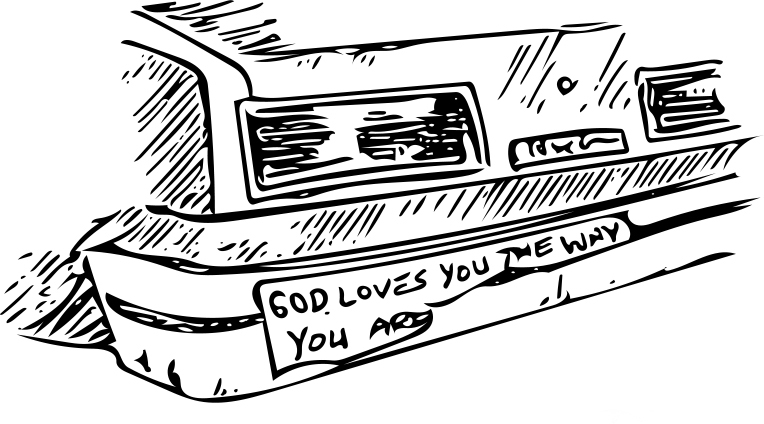
There’s a quote on the lips and bumpers and on the internet that represents a certain kind of thinking well. It’s a pretty good quote.
“God loves you the way you are, but God loves you too much to leave you that way.”
It presents to me an including God who approves of the hymn “Just as I am” but who also has in mind that I will allow the overhaul God knows I so desperately need. There’s enough warmth and truth in this for me to respect it.
But there’s another angle in it to consider as I learn compassion in trade for the desire to control and conform others to my view.
This faith was summarized as love of other. It all hangs on compassion for the other as we want compassion for ourselves. On this hang every law and every tradition, according to who we hold as the Author of it. But many of us have come to believe subtly that the goal is to get right. To change. To surrender to God so that we can be what we were made to be.
Again, there’s some truth in there, but not enough to correct Jesus and say it all comes down to me changing.
I observe people’s pushback on the bumper sticker like this: If God’s real goal is to change me, isn’t this saying God has chiefly in mind to make me into someone else, which means God loves what I might become but is less into me now?
And doesn’t this mean that others, who God has been able to subdue and augment over time, are more acceptable to God than I am in my current pre-changed state?
And doesn’t acceptance equal love in any of our other relationships?
And so doesn’t this mean this is all really a sneaky way of saying God actually loves everyone to different degrees, based on how much they’ve become someone more in conformity with God’s preferences. And, therefore, God’s love is as finicky as mine?
And, what if I don’t want to be like the people God allegedly approves of more? What if what’s presented as “surrendered to God’s will and therefore more in divine alignment” is repulsive to me?
Jesus’s public ministry begins on a hillside and is staggeringly inclusive and gracious.
And the end of his public ministry, found at the very end of the gospel of Matthew, is the same.
“…the eleven disciples went to Galilee, to the mountain Jesus told them to go to. When they saw him, alive and well, they fell down and worshiped him. But some of them doubted. And Jesus approached and said to them, “All heavenly and earthly authority has been given to me. So go, make students of all nations, immersing them into the united reputation and character of the Father, the Son and the Holy Spirit, teaching them to live by all I have commanded you to live by. And know that I am always with you, always.”
Worshipers and doubters. Arms raised and arms folded. Blessed assurance along side eh, I’ve been reading Bart Ehrman, so….
To “them” he spoke. “Them” without distinction. Because compassion for people as they are was Jesus’s whole religion. Despite our familiarity – and our preference– for love being more rooted in a what best promises a return on investment, true love and compassion are actually something else. A prerequisite for change called love is something many of us left as soon as we didn’t have to go to church anymore as younger people.
Perhaps what slowly changes us is learning that even if we don’t change, we are as loved as anyone ever was. Maybe the peace that comes from recognizing I don’t have to behave desperately anymore is what changes me, rather than rules telling me to stop it or else. Maybe that insatiable hunger for acceptance and validation is satisfied when I understand that my performance and achievements don’t buy me love. I am loved because I exist, and therefore there’s noting to extract or persuade or steal. Maybe seeing myself in light of unconditional inclusion helps me to stop settling for superficial responses to my appetites. Maybe I stop believing all I am is appetites altogether.
Maybe what we call “sin” – which in a faith summarized by the Love of other must be defined by the withholding of Love from the other – is remedied by our decreasing desire to use and abuse others. Maybe both St. Paul and Sir Paul were right: Love is all we need.
A lot of garbage, foolishness, sin, and insanity has fallen off me as I have come to learn that Compassion doesn’t cordon off human beings into groups variously close to acceptance and rejection. Rules and ultimatums made me great at masking. Love makes me treat people better. Especially in that some of my junk has stayed with me like wine stains in the rug as a reminder of how hard it is to be human. Just enough calibrated self-awareness to help me resist the self-righteous zealot who wants to make everything a damned pecking-order again.
Good news; We don’t have to change to be included. Nor do we have to include only the changed. Everybody on the hill is invited. Compassion believes that people are all salt and light and beauty under layers of evidence to the contrary. Love is enough to make us everything we already are.
15
The Strangely Transformative Effect of Letting People Be.
A third set of lights and sirens passed a few hundred yards behind our house and, rather than fading into the distance, stopped. Close. Dad muted the the M*A*S*H rerun and pushed away his spaghetti topped TV tray. He craned his neck to see through the window. “What in sam hell?” I still don’t know what this phrase means.
A sheriff’s deputy had raced to the dam at our end of the lake, meeting the other deputies already parked. They cut their sirens, but their lights still had the fall trees strobing Americana. Something big was going down. Big enough for dad to finally turn the TV off on Margaret Houlihan.
“Dad, where are you going?” I asked as masculinely as I could, a halo of spaghetti sauce and a dozen downy hairs on my fourteen year old lip.
“I’ll be right back, stay here.”
My dad had been a cop since before I was born. It was his nature to involve himself in such matters. My brother and I, barely teenagers, watched through the windows as my dad became a small, shimmery silhouette down by the deputy’s cars at the lake.
After twenty minutes he came back through the sliding glass door. He went to his bedroom, to the closet where his uniform and holster hung. As he moved, he explained what had happened.
A man had made a surprise visit to his girlfriend’s house to confront her about her cheating ways. He’d come in to find her with the very man he’d suspected her straying with. Validated, enraged screaming ensued. She implored him to calm down. We’re just talking, it’s not what it looks like. All that. The man was persuaded otherwise, produced a gun and shot the home-wrecker as he sat on the couch.
Dead.
The woman shrieked as the cuckold ran. And he had run to our lake neighborhood, now feared to be trying to gain entrance into one of the few houses on our end of the lake. Our house was as good a candidate as any. Somewhere in this story my young eyes came out of their sockets.
My dad pulled his service revolver, a .357, from its holster. My brother and I were being given curt instructions. Dad was in some mode. He laid another gun on the bed. A snub nose .38 Special. One of those guns TV cops strap to their ankles just in case the last scene calls for it. This gun was assigned to me.
“Stay here, keep the doors locked and stay away from the windows.” I wasn’t to touch the gun unless necessary. Many fathers have the birds and bees talk with their young sons. I was deputized by mine.
Dad slipped out into the dark on a manhunt. I stayed with my brother, pacing from one end of the house to the other, wondering and shuddering. An hour or so passed before my brother and I heard a gunshot echoing and ricocheting like a weak cough through naked trees and dry air. Dad returned and explained to us the man had swam far out into the frigid water my brother and I played and fished in, put his gun in his mouth and pulled the trigger. A murder-suicide in our sleepy little neighborhood. Later that evening I guess we just went to bed. I had no fear for my safety under the power of my father.
I never wanted to be cop as far as I can recall. But I loved the kind of power that came with such a career. My dad was the one dad who caused silence in my friends when he came into the room. I called my friends’ dads by their first names. My friends wouldn’t look my dad in the eye. He had a badge. He held the power of the State of Ohio. He carried death on his hip and made folks’ palms sweat when he drove behind them. There was the law and his enforcement of it. He was an agent of conformity. Conformity not to mere opinions but to what was lawful and right and absolute.
We learn power, and the safety having power provides, our from father figures. This is where I learned it.
At one point I became a pastor. We all want to honor our fathers, and sometimes the best way to honor someone is to expand on their idea. So where dad donned a badge, I did a Bible. He had the state behind his work. I was backed by Heaven. I loved the idea – despite my inability to see and admit it in the beginning – that I could speak and others would be goaded to change their path. I carried life and death, translated into readable English with notes and maps, on my hip. I was an agent of conformity. Conformity not to mere opinions but to what was lawful and right and absolute.
It’s hard to to be compassionate when what is valued most is the effort to control and convert. I’ve come to believe that for most this blend is impossible. Compassion is in large part the suspension of power so the interests of others can be put first. It’s that vulnerable, uncomfortable place that says, through gnashed teeth, Despite my impulse to make sure my will has prominence, my desire to have control, to have you conform to my way rather than the other way around, I concede. Because this is the arrangement I want, I will act in a way that gives this very thing to you.
Learning compassion for others is in large part my healing from an addiction to power and my from my lust to conform others to my – however well justified – will. I am never less loving of you than when I am trying to reshape you into something more in keeping with my views and preferences. In fact, that’s me loving me, disguised poorly as me loving “you.”
Compassion insists I love you as you are. That I let my observable life be my authoritative statement on what I think is best. Let my life do the talking for as it pertains to what I think is right and beautiful and good. All the while I’m allowing you to, as the kids say, do you.
Convert me, love you. This is one of the most important four-word sentences I know, so long as they’re in this order.
I’ve found it interesting as one understood to be part of the Evangelical way but to have suspended the impulse to change people. Not because I don’t care about people, but because I’m actually beginning to. I swear Love made me do it. Love is inviting us all to do it. To put down our tensely clutched “badges” and our biblically and morally and academically and politically and economically and relationally backed justifications for demanding others conform to our way, and to let them walk their path, as we would hope they’d do for us. I don’t imply those who more directly associate with the label “Evangelical” will automatically make the mistake of loving people less. I merely offer a caution by way of my own experience: Conversion-as-spiritual-identity, whatever the label, sets the stage for exactly this mistake.
“Do nothing from selfish ambition or conceit, but in humility count others more significant than yourselves.”
The first woman saw an old house, deteriorated and neglected, and began to dream of fully restoring it to its intended condition.
The second woman looked at an old house, curled her nose, and took to sketching out her dream home.
The first sought to understand the original architecture, the period’s wood and stone, the history of the property and those who had used the house before.
The second comparison-priced general contractors, then went shopping for paint colors, sofas and interior design magazines.
The first worked tirelessly, patiently restoring the interior and exterior of the house in perfect accord with its former self.
The second changed and updated every interior and exterior surface, painting and modernizing in perfect accord with her tastes and the latest trends.
The first was thrilled to see the house returning to itself after so many years.
The second was thrilled to see her plans becoming a reality.
The first woman, after a great many months, made the house everything it was meant to be.
The second woman soon made the house everything she’d always wanted.
Both women’s hearts were good.
But only the first house felt loved.
14
CTRL. Alt. Delete.
I was five, running through the house with a blue towel tied at my neck like a cape. It was evening, and I can remember the florescent light of the kitchen and the aerator on the aquarium gurgling. I was Batman, with no mask, no crime to fight and plenty of pre-bed energy to expend.
My dad staggered out of the back hall in his underwear, infuriated at not being asleep. He was working swing shifts as a young State Highway Patrolman. Mom had been shushing me, but Batman had managed to awaken a real, exhausted crimefighter anyway. He grabbed my towel as I ran by in an impulse of irritability.
I had not just awakened him. I had made him really angry.
We learned as young children a person’s mood and enjoyment of life were a contingency. A contingency others controlled.
Your noise level, willingness to eat vegetables, your punctuality, attention to detail, grades, room cleanliness; all were the major determiners of mom and dad’s mood, and how you might be treated as a result of that mood.
In other words, you’ve known most of your life you were in control of people, especially powerful people, and they were in control of you.
My mom says it happened in less than a second. The towel jerked tight in my dad’s strong hand, my feeble knot slipped open. My little frame spun like an Irish dreidel into the kitchen table, my forehead gashing open on one of the spindly legs. The rest of the memory is a whirling blur of my apologetic father holding me in his arms, carrying me into the brightly lit emergency room, surgical sheets over my head, the sting of the needle as they injected a local, dad holding my hand as they stitched me up, dad petting me, dad making jokes. Most significantly, I remember I had never seen my dad so upset, so accommodating, so willing to eat out of my hand.
I clearly remember his anger, as well as the strange satisfaction of his remorse. The anger I had caused, waking him from much-needed sleep and my innocent insensitivity to how tired he was.
But I had influenced his remorse too. And I fanned the flames of this remorse, mindful in my five-year-old way that it was my hand on the dial of his guilt. I was punishing him, and it was working. A long history of a father and a son puppeteering the mood of the other was born.
When I walked into the front room recently, my son’s socks were crumpled on the couch next to his shoes, his legos, a book and some trash from a snack. I bellowed his name, demanding he clean it up. I felt the anger and frustration coursing through my veins. I would have said it to my friends like this.
It pisses me off when the kids don’t listen.
The kids really infuriate me with their disrespect.
This is to say, I’m a grown man and my children have the power to dictate my mood to me. And they suffer for it, because I believe they’ve caused suffering. So I perpetuate the silly, devastating lie that my children caused my upset. Worse, my children don’t learn in cases like this the supposed moral value of a clean house or taking responsibility or being respectful or any such manure I tell myself I’m trying to instill during my tirades.
I transfer the teacher far more than the teaching. Container far more than contents.
I’m teaching in those moments that children control their parents. I’m teaching in those moments that when they grow up, when they encounter something they don’t like, they should blow up. Upset themselves as though controlled by all the world but themselves.
My kids aren’t learning the value of a clean home, if a “clean home” even has any value beyond individual preference. Whoever first said cleanliness is next to Godliness was probably unaware of the hellish false equivalency they were immortalizing forever. When I become angered at my children for their performance, I am teaching them that when the universe doesn’t conform to their will, just throw an adult tantrum and season it with a pinch of moral justification. Then everything will be just how they want.
My son didn’t learn about picking up Legos. My son learned yelling about Legos.
You “made them angry” or “saddened them” or “ruined their morning”, our parents. In some truly unfortunate cases, kids even heard parents or relatives tell them, “you make me sick” for simply behaving like a kid. Same with teachers and other adults. You and I were given control over them, and then had to suffer the consequences for handling this insane responsibility badly.
It’s a stupid thing to do, handing children control over adult happiness. It’s control the younger version of us thought we wanted and perhaps even thought we’d mastered early on. Children love puppets after all. But by the time we realize that the inability of our parents to deal with all our unbridle-able youth will generally result in our own misery, it’s far too late to give the remote control back.
Jesus, teach us to pray.
“Our Father, who art in heaven….”
Uh oh.
Good or bad, how we perceive parents of course informs how we see God. Parents and teachers are probably our first gods.
A tangent on the wrath of God, in light of the direct connection we make to our parents, is in order: How many times in the last year have you heard that a person or a group has beliefs or behaviors that anger God? That God’s wrath is kindled by someone’s ideas and actions, the clear implication being God’s mood was ruined by human action in the same way dad’s could be by leaving your bike in the yard for the third time. It’s an arrogant message for sure; little you and I, controlling the Lord of the Universe’s ability to enjoy all that’s been made.
God was having a great day until you arrived.
That’s one powerful little sinner. God as a shower head raining down on us whatever temperature we dial up on the faucets. A God that can’t claim the All in Almighty.
This is perhaps why it’s so hard for some to respect the Object of Christian faith. We depict God as a god whose creations can dictate his state of mind. For people who believe humanity has free will, it’s interesting to conclude humanity’s God does not. For people who don’t believe in free will, it’s even more interesting, since now we’re talking about anger God causes God’s self.
There are numerous passages and entire stories in the scriptures which highlight the wrath of God. Most of us couldn’t understand the point of our faith, or the fundamental narrative of the Bible without God’s wrath. But in our constantly morphing view of the Almighty, isn’t it possible, perhaps even likely, that depicting God as angry was the most effective way to show that God is not indifferent? That God is interested and involved and has, for example, taken notice of those victimizing others with their abuse of power. With time aren’t we learning, like Dallas Willard insisted, that “anything you can do with anger you can do better without it”? Aren’t we becoming aware that anger is a physiological reaction, an emotion, caused by something being in the way of what you want? Do we really believe God angers because God is thwarted?
Or look at it this way; if a person gets angry and behaves accordingly, that person also very likely has the ability to be happy – elated even – and laugh. Both are emotional responses to external stimuli. But the Bible never depicts God as having a good laugh. Mocking heathens and scoffing at them, yes, but the scripture never presents God as so much as chuckling.
Are we really excited to spend eternity with a God capable of wrath and not laughter? A God infuriated by liberals online, but who doesn’t laugh at cat videos? If we’re not excited, we’re probably too terrified to admit it.
Jesus said if you’ve seen me you’ve seen the Father. Someone else said that Christ is an exact stamp of what God is. And this Christ didn’t go around getting things done with intimidation. This Christ actually told people not to be intimidated. Probably because he knew that if you are scared that your behavior could spoil the Cosmic mood, you’ll hide and never have the peace people of faith are supposed to have. You will lie. You will avoid. And even if you call the way you hide your inner world “holiness,” it’s still an awful, anxiety-ridden lie.
A man tells his new bride he’ll be ten minutes late. She huffs in a display of aggravation. When he gets home, she has a certain edge to her mood. The next time it happens the same way. His punctuality is proving to be the knob controlling her joy.
A manager becomes a relational minefield when store numbers are low. Especially toward the end of the quarter. The performance of the team doesn’t just affect revenue. It actually controls their manager’s mood with subsequent effects on the office atmosphere.
A kid tells her parent that her grades are slipping and asks for help. Rather than a supportive response for help and understanding, disappointment fogs the room. Dad is not happy now.
In each case, people discover that someone becomes unsafe when they’re told the truth. They have the same problem Jack Nicholson accused Tom Cruise of. And so they are motivated to protect both themselves and the other from the whole story, because moody beings tend to have little capacity for what’s true.
The man calls his wife and says he’ll be home in 5 minutes, knowing he’s 20 minutes away. He’ll blame traffic or something later. For now, pacify with lies. He’s wrong to lie. But he’s preserving himself.
Many of the members of the sales team pad their numbers, make up sales call reports, inflate numbers and more, because their overseer is so easily overwhelmed. The truth may come out later, but for now they pacify with lies. These lies are wrong, but the tactic preserves at least a semblance of peace.
The child did everything in her understanding to improve grades. It didn’t work. So she blames a surprise test. She hides report cards. She figures out an “F” can be transformed into a “B” with no artistic effort at all. Mom and dad showed themselves unable to remain happy unless things were just so. In the absence of having what’s needed to “make them happy”, the girl lies. She’s wrong for doing so, but her parents’ bad mood is under her control and who willingly tanks others’ moods when they know how to avoid doing so?
Some aren’t willing to lie. But they are willing to avoid you or not tell you anything at all. Same motivator. When someone’s mood proves to be circumstantial, their joy conditional- nobody wants to mess with those circumstances and conditions. If you show that your happiness and approval are dependent on specific outcomes and performances, you will often be lied to, sometimes avoided, and sometimes deliberately left out of the loop “for your own protection.”
Paul listed nine words that reflect tangible evidence that the Spirit, rather than the tick, are influencing our behavior:
Again, these words are about what we provide to the experience of others. The arrows turned more away than toward the self. The evidence of the Spirit’s sway in my life begins with love of others and ends, for Paul, with me controlling me. Not you. Not circumstances. Not the weather. Not the outcome of the election. Frankly, not even God despite the loftiness of the request that God take me over.
Apparently my refusal to allow anyone power over what I am or how I feel is an act of courageous compassion. I take from you the ability to shape my mood. I withdraw from you my blame, my faultfinding, my enjoyment of life. I control me, not you. You’re welcome.
There are days where I wish the fruit of the spirit was that I got to control others. Or control circumstances to confirm them to my liking. And there are just as many days that I wish the fruit of the spirit was an inspired ability to assign blame for all those responsible for my soured disposition and lack of happiness.
And yet, there’s a real sense of power that comes from knowing my Christ wants to teach me the Compassion and the strength of not being so subject to the (mis)behavior and (s)words of others. To take back the remote and responsibility for the enjoyment of my own life.
13
Detour Ahead. Don’t Take it.
Jesus got to the wilderness in Matthew chapter 4, fasting and praying. If he’s getting ready to go show the world how to love, how to wake up and be what they are, then this little ascetic trip to the desert must have been about something more than proving how tough he was. It must have been endurance training for a life thrust into relational environments that give little, but absorb much. It was a tough experience, fasting gin the desert. But i bet there were days with the disciples where Jesus longed to go back to the relative blessedness of starvation and heat stroke.
Just as the hunger and the isolation were about to start messing with Jesus’s head, over a month in, the Tempter starts up a conversation about relief.
Noting Jesus used scripture to make his points, the Devil took a stab at quoting from the Good Book himself. He’d taken Jesus to the highest point of the Temple after failing to get him to turn stones into bread. He’d not been able to get him to give into his belly, so he was using the Bible to goad Jesus to do a multi-storey trust fall for the Lord.
“If you are the Son of God, throw yourself off,” the Devil said to Jesus as they stood on the pinnacle of the Temple. “Because, it’s written,
“‘He will command his angels concerning you,’
and
“‘On their hands they will bear you up,
lest you strike your foot against a stone.’”
The Devil was quoting from Psalm 91, written several hundred years before. But he was doing so selectively. There is a peculiar omission he makes from the text from the old Psalm, leaving us to wonder what he was trying to avoid.
If you go back to read the actual psalm, you’ll find the passage he was quoting from in its entirety reads this way:
For he will command his angels concerning you
to guard you in all your ways.
On their hands they will bear you up,
lest you strike your foot against a stone.
In the Hebrew language, the word translated “ways” is the word you might use to describe someone’s behaviors or intentions. But generally, it’s the word used to describe an actual path or a road.
Literal and figurative journeys.
The Devil intentionally leaves out the part about traversing the distance between here and there. As though he didn’t want Jesus thinking about the journey, just the end. The reward, but not the work to get there.
At the end of a forty-day fast, Jesus would leave the desert, be reunited with family and friends at home, and eat. The Tempter said “Why wait? Eat here and now.”
Jesus wanted to put his awakened, others-centered life on display so that people would trust The Way and not their religious fabrications. The Tempter said “Why wait? Prove the goodness of God now.”
Jesus insisted power isn’t something held over others, but something that comes up from underneath, humble and serving. The Tempter said “Why wait? Have all the power now.”
The whole exchange shows the Devil taking Jesus to the Temple, taking Jesus to the Mountain, removing the awareness of a journey. The journey was made to seem like a clumsy detail. Shortcuts and clipped corners. Let’s get to the pay off. And yet Jesus continues to resist, choosing more meaningful results via harder means. Luke resisting the Emperor’s invitation to embrace the Dark Side’s fast track comes to mind. Both scenes feature robes.
The word Compassion is two words, meaning “together suffer.” It’s difficult to understand how I can simultaneously live as one committed primarily to avoiding difficulty while growing in my ability to enduring suffer with others. Shortcuts often excise awareness and love. Doesn’t the bypass usually steer us around the more troubled parts of town?
As though life can always be reduced to an industrious Work Smarter – Not Harder, you and I are ever tempted to avoid Love’s hard roads. On the level of instinct, or at least the level of an untrained, drip tray of a mind, we want favorable ends in our social standing, by whatever means necessary. The self-centered animal willingly reduces itself to an isolated, petty relief-hunter who wants nothing as much as immediate gratification and ease. One who gets angry when its course and schedule are interrupted. One who begins to see people as obstacles to overcome rather than the objects of its Compassion. It scouts out easy paths and demands others do their part to take hardship out of their journey. Pissed off people in the express lane, mad at the children for interrupting sleep, vilifying the President for taking the country and the economy in a direction not fitting their preferences. Everything is colored by an increasing inability to cope with delays and disappointment, an unwillingness to submit to others’ pace or to the Universe’s uncontrollable outcomes. And this not getting what we want when we want it actually becomes a kind of pain, a kind of suffering, expressed in eye rolls or divorce or criticisms or the unfollow button. People are just too hard to deal with.
And the easy road is paved with the swiftest judgments. There’s no lazier path than getting quickly to a verdict on who you are. For many of us it’s intolerable to turn off the easy road and really know someone past impressions. A habitual shortcut taker is always confidant he knows the lay of the land and can’t be told otherwise. Not only am I less and less patient with the pace and strain of real life, I can less and less be burdened with knowing you beyond the cartoon I’ve made of you in my head.
“Compassion is the sometimes fatal capacity for feeling what it is like to live inside somebody else’s skin.”
We’re losing the ability to together suffer, because our goal is to excel and be relieved, have our minds all made up. But not suffer.
Christ takes the long road not so we’ll be impressed, but because his goal was Love of others, which can only be encountered in the exhausting, patience-demanding, grace-drawing paths of real life.
Then he said “follow me.”
Not around, but through. It’s a far more difficult road to walk than the bypass of self-interest, or academically focused religion.
I love being first and most powerful and at the top. To take the detour around all the frustratingly underdeveloped, under-informed, wrong and annoying people around me to secure for myself a personal paradise. And yet I’ve never felt less loved than when I was told I was in your way, that I was an anchor to be cut from your leg, a social liability to be quarantined, an annoyance, a draw on your emotional account, one requiring too much of your time and space for you to have the day you wanted to have. I know what it’s like to be the subject of a workaround.
So I choose the narrow path, so long as I remember to choose it, trying to ignore all the invitations to bypass you on my way to where I want to go.